

The Guide
Designing to Win emulates the format of a floral competition as a way to examine design decisions more closely. You work with a competition-style schedule and evaluation criteria, but the purpose is learning rather than ranking. The submitted designs are analysed, rather than scored against each other.
Everyone takes part in the same learning process. Designers and Observers have access to the same programme materials, Design Forums, analysis, recordings, notes and opportunities to ask questions. The difference is in how you engage with that process.
As a Designer, you also respond to the schedule with the work you've created. Your designs become part of the shared analysis, and you have the opportunity to apply what you learn through a second response to the same design problem.
As an Observer, you don't submit a design. Instead, you can concentrate on the complete field of work, without the pressure of performing in a competition-like environment. You see how different people interpret the same schedule, the decisions they make, what those decisions produce, and how their responses develop after the first Forum.
You don't need previous competition experience to take part. If you join as a Designer, you should be able to make a floral design independently from a brief. If you prefer to concentrate on analysis without making and submitting your own work, Observer participation gives you access to the same shared learning process.
Designing to Win timetable and meeting format
Use the timetable below for the region in which you registered.
Both Design Forums are recorded for all time zones, so you don't need to attend live to take part. Joining live gives you the additional opportunity to ask questions and participate in the discussion as the designs are analysed.
Designing to Win is a complete learning cycle built around one competition-style schedule. The two Design Forums are important stages in that cycle, but much of the learning happens in the movement from one stage to the next.
You begin with the programme materials and the schedule. These provide the competition context and the framework everyone will use to examine the designs.
Designers then develop their first response to the schedule and submit photographs of their work. Observers don't make a submission, but they work from the same schedule and materials so that everyone comes to the first Forum with the same design problem in view.
In Design Forum #1, we analyse each submitted design against the schedule and the evaluation criteria. We look at the decisions that have been made, what those decisions are producing, where they are working and what might be reconsidered.
That analysis becomes the starting point for the next stage. Designers respond to what they have learned by developing a second response to the same schedule. That might mean making a few targeted changes, substantially revising the original idea, or taking a different approach altogether. The aim isn't to preserve the first design. It is to use what you have learned.
In Design Forum #2, we bring the first and second responses together. Comparing them allows us to see what changed, what remained, why particular decisions were reconsidered and what effect those later decisions had.
Throughout the process, everyone learns from the complete field of work. Designers can apply the analysis directly to their own response, while Observers can follow how the same feedback and principles play out across many different designs.
After the Forums, the recordings, written notes and Competition Learnings resource allow you to return to the analysis and comparisons. The learning doesn't end with the live discussion. You retain a record of the decisions, changes and consequences that emerged across the full cycle.
Designing to Win has a clear sequence, but there is room to respond to circumstances as they arise.
You don't have to attend either Design Forum live. Both are recorded, and the written notes give you another way to work through the analysis afterwards. Joining live gives you the opportunity to take part in the discussion and ask questions as they occur, but missing a Forum doesn't prevent you from continuing with the process.
For Designers, the second response is deliberately flexible. You might make a few specific changes to your first design, revise it substantially, change materials, mechanics or construction, or develop an entirely new response to the same schedule. Keeping some visual connection between the two responses can make comparison easier, but it isn't a requirement. The important thing is to use what you learned from the first analysis in whatever way is most useful.
If circumstances prevent you from completing a submission on time, let Mark know and continue when you can. You can still receive feedback for your development, although late work may not be included in the Forum presentation or the final Competition Learnings resource.
The flexibility is there to help you stay engaged with the learning process when things don't go exactly to plan. It doesn't change the underlying purpose: to work through the schedule, analysis, reconsideration and comparison as fully as your circumstances allow.
Questions are part of the Designing to Win process, and they don't need to wait until a Design Forum.
You can ask questions about the schedule, the programme materials or anything that needs clarification as you work through them. Designers can also ask about their submission, their feedback or the development of their second response.
Questions often arise after a Forum as well as during it. You may think of something while reading the notes, watching the recording or reconsidering a point from the discussion. As an Observer or as a Designer, you can contact Mark between Forums rather than waiting for the next live session.
If you attend a Forum live, you can also ask questions in the Q&A session. This can be particularly useful when the analysis of one design raises a broader question that applies to other responses or to competition work more generally.
The aim is to make sure you can keep moving through the process with a clear understanding of what you're doing and why, rather than leaving useful questions unresolved until the next stage.
You don't need expensive, unusual or abundant materials to take part.
Use flowers, foliage and other materials that you can source easily and affordably. The learning comes from the decisions you make with them, rather than from how much you spend or how elaborate the material selection is.
The same applies to mechanics and construction. You can use methods you already know and trust, or experiment with something new if that serves the design. Existing baskets, frames or other structures from earlier work can also be reused where they suit the response.
Between your first and second submissions, you can retain the same materials and mechanics or change them if the first analysis suggests another approach would be more useful.
The important thing is to choose materials and construction methods that support your response to the schedule and allow you to concentrate on the design problem itself.
The analysis is based on the photographs you submit, so the aim is to represent your design as clearly and accurately as possible.
- Use a phone camera or basic digital camera.
- Use a clear, neutral background where possible.
- If the design needs staging, keep it simple. A plain table or plinth generally works well.
- Use reasonable, diffused light and take care that the colours in the photograph represent the materials accurately.
- Leave enough space around the design for its complete outline to be seen. Avoid cropping it too tightly.
- Include a clear photograph of the complete design, usually from the front or from the viewing position that best represents it.
- Pay attention to camera height and angle. The photograph should represent the design and its intended setting accurately rather than distort its proportions or viewpoint.
- Additional views can be useful where they show depth, construction or details that are difficult to understand from the main image.
- Basic cropping, straightening, lighting and colour correction are fine. Don't digitally alter the design itself.
- If you use a digital background, take particular care that it doesn't change the appearance, outline or colour balance of the design.
Choosing which photographs to submit is useful in itself. Looking at several views and deciding which ones represent the design most accurately asks you to examine how the work reads when it is reduced from three dimensions to a photograph.
The feedback in Designing to Win is based on the same kinds of questions that matter in competition judging, but the purpose is different. We use the schedule and evaluation criteria as a framework for analysis rather than as a way to score or rank the designs.
We look first at how the design responds to the schedule. That includes the interpretation, the requirements of the brief and any constraints that affect how the work would be judged.
From there, the analysis considers the design decisions themselves. We look at principles and elements of design, overall effect, workmanship and construction, and at the relationship between the decisions you intended to make and what is actually visible in the finished work.
The aim isn't simply to identify what is wrong. It is to understand what a particular decision is doing. Some decisions may already be working strongly. Others may introduce a risk, weaken the response to the brief or create an opportunity for development.
Where a change may be useful, the feedback doesn't assume there is only one correct solution. We can consider different ways of responding and what each might produce.
For Designers, this gives you material to work with as you develop your second response. For Observers, it gives you the opportunity to examine the reasoning behind the analysis without the pressure of having your own work under review.
In both cases, the purpose is to become better at looking at design decisions objectively, separating intention from visible result, and understanding more clearly how those decisions may be read in a competition context.
One of the most useful parts of Designing to Win is that everyone is studying the same design problem.
A single response can show the consequences of one set of decisions. A group of responses shows something much broader. You can see how different people interpret the same schedule, what they choose to emphasise, how they use materials and mechanics, where similar ideas lead to different results, and where very different ideas solve the same problem successfully.
Because every submitted design is analysed, the learning isn't confined to the person whose work is being discussed. Each response becomes another opportunity to examine how design decisions affect the outcome.
The comparison becomes even more useful after the second submissions. You can see which decisions were retained, which were changed, and what happened as a result. Sometimes a small adjustment makes the effect of one decision especially clear. In other cases, a very different second response can reveal what was learned by changing direction altogether.
For Designers, this means you learn from much more than your own two responses. For Observers, the advantage is especially clear: you can survey the whole process with some detachment, without the performance pressure of producing a design yourself, and concentrate on how decisions and consequences play out across the full field.
The group therefore expands the amount of learning available from a single schedule. You aren't only asking, “What happened in this design?” You can also ask, “What happens when different designers solve the same problem in different ways?”
If you participate as a Designer, your submitted photographs become part of the shared learning process. They are shown in the Design Forums so that everyone can follow the analysis, and may also be included in the final Competition Learnings resource.
Under our standard Terms & Conditions, Flower Thinking may also use photographs of your work in places such as galleries, social media posts and emails.
If you don't want your work used outside the Designing to Win learning process, just let us know. We will respect that preference.
You can join Designing to Win after it has started, but the practical implications are different for Designers and Observers.
As an Observer, you can join later if places remain and work through the programme materials, Forum recordings and written notes at your own pace. Because you aren't preparing submissions, you can catch up without time pressure.
As a Designer, joining after the first Forum is possible, but it puts more pressure on the process. You need to develop and submit your first response, work through the first-round analysis, and then prepare your second response within the time that remains.
If you're considering joining late as a Designer, the important question is whether you can give yourself enough time to engage properly with both responses and the learning between them.
Before you decide
As a Designer, you work through Designing to Win with your own design. You respond to the brief, submit your work for both Design Forums, and apply what you learn from the first round to your second response.
As an Observer, you learn from the full group. You see a wide range of responses to the brief, hear each one analysed, and see them evolve with an impartiality that comes from observing with detachment. You also receive the course materials, join both Design Forums and take part in the question and answer sessions.
You don't need previous competition experience. The mentorship and support offered throughout Designing to Win make it an ideal entry point if you are considering competing for the first time.
Designing to Win can also be useful if you already compete or are returning to competition after a break.
You don't need to be an experienced competitor, but joining as a Designer assumes that you can make a floral design independently from a brief.
If you would rather concentrate on the analysis without making and submitting your own work, you can join as an Observer. You will still see all of the submitted designs and share in the discussions and learning from both Design Forums.
Designing to Win uses a competition-style schedule and its marking criteria as tools for analysing the designs, but the submissions are not point-scored or ranked against one another.
The purpose is to understand how each design responds to the schedule, where it could gain or lose marks in a competition, and what could be changed to make the response more successful.
You don't need to attend the Design Forums live. Both forums are recorded, and you receive links to watch them afterwards.
Joining live gives you the opportunity to ask questions during the discussion, but you can also work through the recordings at a time that suits you.
For Observers, your time commitment is largely up to you. You can read the eBooks, watch their companion videos and attend or watch the two Design Forums at your own pace.
Past Designers have reported allowing 5 to 10 hours for each of the two exercises: time to interpret the schedule, and to develop, make and photograph their designs. How long the practical work takes will depend on the design you choose to make.
You make a design in response to the Designing to Win schedule and submit photographs of the completed work for Design Forum #1.
After the first forum, you have the opportunity to apply what you have learned and make a second submission based on the same schedule. Design Forum #2 compares the two responses and examines what changed and why, and what those changes produced.
Your photographs need to represent the design clearly enough for it to be analysed properly.
Use a plain or neutral background where possible and include a clear frontal view of the complete design. Additional views can help show its depth, construction and other details that are difficult to read from the front.
Pay attention to camera height and angle so the photograph represents the design and its intended setting accurately. Basic corrections such as cropping, straightening, lighting and colour correction are acceptable, but the design itself should not be digitally altered.
The aim of the second submission is to respond to what you learned from the first Design Forum. You might remake your first design with a few specific changes, revise it substantially, change a container or construction choice that caused a problem, or develop a new response to the same schedule.
Where practical, keeping some visual connection between the two submissions can make the learning easier to see when they are compared. That connection might come from the container, mechanics, materials, colour scheme or another part of the original idea. It is useful, but it is not an absolute requirement.
Just let Mark know and try to complete it when you can. Mark will still give you the feedback for your development but the design(s) may not make it into the presentations and Competition Learnings ebook.
Yes. Shared analysis is at the heart of Designing to Win. The submitted designs are examined during the Design Forums, which are attended by both Designers and Observers.
That is part of the value of the programme: everyone can see how different designers respond to the same schedule, what decisions they make, what Mark identifies in the analysis, and how those observations are applied in the second submissions.
Yes. You can contact Mark with questions about the schedule, your first submission, the feedback you received or the development of your second submission. You're also welcome to share your questions after the sessions, particularly if something occurs to you while reading the notes or watching a recording.
Pricing is deliberately flat so the course is as affordable as possible for everyone, which means there are no discounts or group rates available.
If places remain, yes. As an Observer, you can join at any time and catch up with the reading and recordings at your own pace. If joining as a Designer, you can join after the first forum, but this could place you under considerable pressure to submit your first design, reflect on the feedback and revisit it in time for the second forum.
Yes, the core benefit of Designing to Win is the ability for both Designers and Observers to share in the learnings, to hear the feedback across the full range of entries, and to witness the resulting revisions.
Observers receive the same course materials as the Designers and the same opportunities to participate in the Q&A sessions in the forums.
Mark works through the submitted designs against the schedule, considering interpretation, marking criteria, design principles, overall effect and workmanship. He identifies where decisions are working, where marks might be gained or lost in competition, and what could be reconsidered or developed.
Design Forum #1 focuses on the first submissions and provides feedback for Designers to take into their second response. Design Forum #2 compares the two submissions, looking at what changed, why it changed and what those changes produced. Designers and Observers can participate in the discussion and Q&A throughout.
Mark objectively analyses the designs as he would if judging them in competition, but deliberately avoids scoring or ranking them. This is because the objective of Designing to Win is not to compare Designers or their work against each other, but to encourage each Designer's personal growth through the two submissions and feedback sessions.
Mark is a firm believer in resourceful designing and encourages you to use whatever you can source easily and affordably. He's often to be found, secateurs in hand, foraging from verges, paddocks and his own garden. Good designing is about choices. Expensive or abundant materials are not necessary.
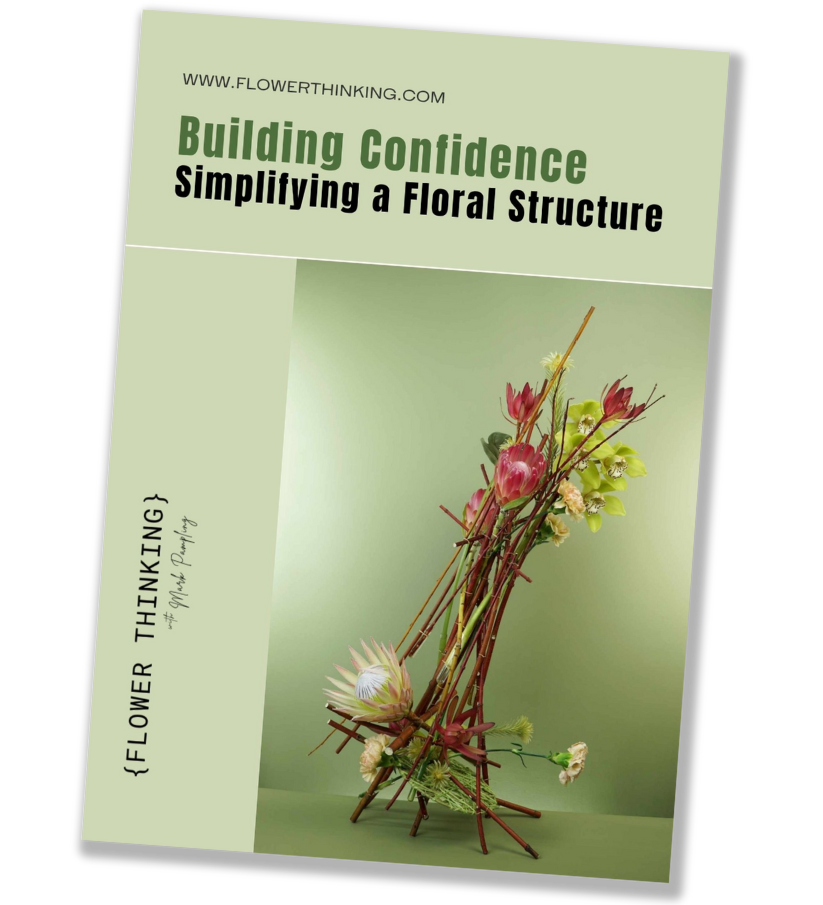
Use construction methods and mechanics that you are comfortable with to make your designs work for you. You might choose techniques you're already confident with, or experiment with something new. You might also want to use prefabricated structures such as baskets or frames salvaged from something you made before. Mark's eBooks Building Confidence - Simplifying a Floral Structure and Interwoven Possibilities - Designing with Bamboo Mats offer a range of ideas around this.
The purpose of the second submission is to respond to what you learned from the first Design Forum, so you can keep or change the container, mechanics and materials as needed.
Where practical, retaining some visual connection between the two submissions can make the effects of your changes easier to see and discuss. That connection might come from the container, mechanics, materials, colour scheme or another recognisable part of the original idea, but this is a guideline rather than a requirement.
You can, but please take care to avoid changes to the photograph that alter the design itself. Careful choice of a neutral background and good lighting will help you avoid altering the colour balance of the materials in the design.
Use basic photographic editing to clean up stray background artefacts or compensate for poor lighting conditions, but avoid digitally altering the design itself.
Absolutely, and it is encouraged. The process of articulating your decisions to someone else often helps clarify your own design process.
Yes. Written notes are provided shortly after each forum, and are also captured in the final eBook, Competition Learnings.
The size limits here are defined in the schedule.
Work from the schedule in front of you rather than assumptions carried over from another competition. The wording, requirements and evaluation criteria are the framework for the design problem you are studying.
Don't treat the feedback as a search for the one correct solution. A design problem can often be answered successfully in several different ways. The useful question is what your decisions are producing, and what might happen if those decisions change.
If you're participating as a Designer, give yourself permission to respond honestly to what you learn. Your second response doesn't need to defend or preserve your first one.
And whichever way you participate, look beyond the individual designs. In most competitions, competitors hear the feedback on their own work, while observers generally don't have access to the detailed analysis. Designing to Win opens that analysis across the whole field, so you can learn not only from one response, but from how different decisions play out across many responses to the same design problem.
Keep The Guide with you
Leave your email and we'll send the PDF version of this guide, for reference before and during the course.
What you're getting
- Your Designing to Win dates and meeting format
- How the programme cycle works, step by step
- Guidance for choosing and working with your materials
- Photography guidance, so your work is represented accurately
- Information about reviews, revisions, missed work and support
Reserve your place
Designer or Observer
Three eBooks with their companion videos, and two live Design Forums.
Choosing how to participate
Designing to Win gives you a competition-style design problem and a structured way to examine the decisions that shape the result.
Join as a Designer and develop your own response to the schedule. Your work becomes part of the shared analysis, then you apply what you learn through a second response.
Join as an Observer and follow the same process without producing your own submission. You can concentrate on the complete field of work and study the analysis with some detachment from the pressure of creating.
In both modes, you receive the same programme materials, three eBooks with companion videos, two Design Forums, recordings, written notes and opportunities to ask questions.
The Forums examine interpretation, design, workmanship and overall effect, using the competition schedule and marking criteria as a framework for analysis rather than ranking.