

Designing to Win
Learn How To Maximise Your Success In Competitions, from accomplished Competitor, Teacher and Floral Design Judge, Mark Pampling.
Participate in a comprehensive learning package built around a structured process of analysis, application and comparison, with three eBooks and their companion videos, and two live forums.
The theme for this edition of Designing to Win is Between the Gaps.

What does it take to succeed in floral design competitions?
We know that succeeding in floral design competitions takes more than good design and creative interpretation. You are working to a schedule and marking criteria, so interpretation, design and workmanship all have to answer the problem you have been given.
Designing to Win uses that competition structure as a way to examine design decisions more closely. We work from one competition-style schedule, analyse the different responses to it, apply what we learn and compare what those decisions produce.
Designers and Observers alike learn from the full field, seeing how different choices answer the same design problem and where those choices may gain or lose marks in competition.

For Designers, that includes applying the analysis directly in a second response to the same schedule.
Drawing on 35 years as a competitor, judge, mentor and competition convenor, Mark guides that analysis and helps you consider interpretation, design, workmanship and the marking criteria more deliberately.
The aim remains practical: to increase your chances of achieving the highest possible placing in competition, while developing a more objective way of analysing design decisions that you can carry into your designing more broadly.
Between the Gaps
Create an arrangement for display in the entry of an Art Gallery at the opening of an exhibition of contemporary paintings titled ‘Between the Gaps’.
The gallery entry is a modern, raw concrete environment, with textured block walls and matching floor in cool grey tones.
The design will be displayed on a concrete plinth, against a wall.
How will you approach the Schedule for Between the Gaps?
Three eBooks, each with its companion video

Floral Competition Essentials
Floral Competition Essentials is Mark’s essential guide to maximising your chances of success in floral design competitions.
It covers a broad range of aspects of competing: researching competitions, analysing and interpreting the schedule, understanding the marking criteria, designing, planning and preparing for competitions, and reviewing your competition results and learnings afterward.
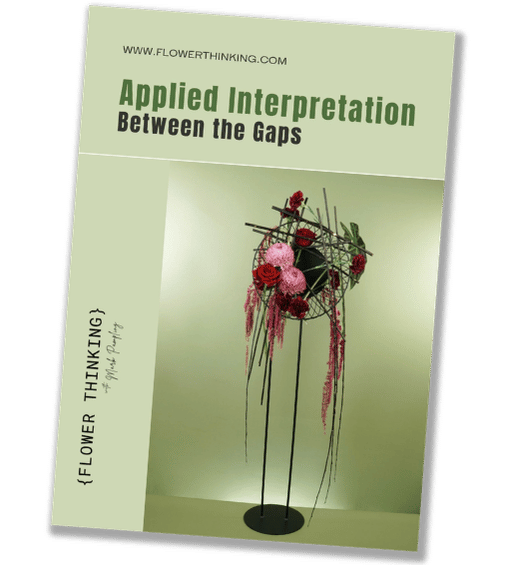
Applied Interpretation
Between the Gaps works a conceptual theme, which as a category is harder to interpret than themes that name an object. This edition exercises the method on that harder kind of theme.
Follow Mark as he works through the schedule, analysing the theme and identifying design solutions that answer this specific schedule and marking criteria. Then read on as he applies the analysis to three example designs created for this event.
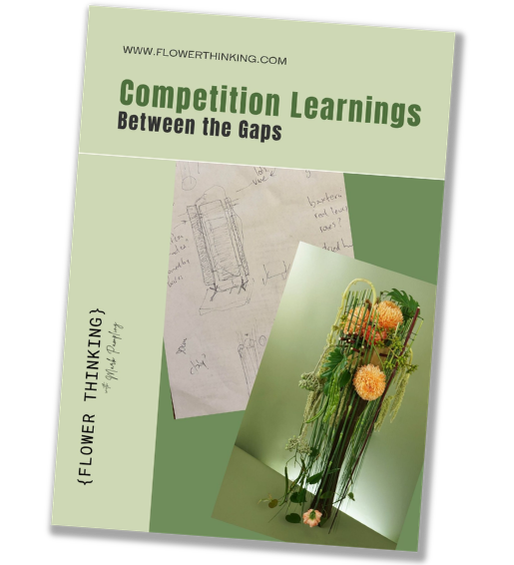
Competition Learnings
The Competition Learnings eBook (with the forum recordings) captures the progression from the first response, through the analysis and feedback, to the second response.
It’s a durable record of all of the designers’ items submitted for the first and second Design Forums, with the detailed notes from Mark’s critical appraisals, highlighting, for each designer, what was learned from the first response and how that learning was applied in the second.
How the eBooks work together
Floral Competition Essentials establishes the broader competition framework. Applied Interpretation then applies that thinking to the Between the Gaps schedule, showing how the theme, setting, occasion, constraints and marking criteria can all contribute to design direction.
The forum recordings and Competition Learnings carry that process into the group work, preserving the analysis and comparison across the first and second responses.

What you gain from Applied Interpretation
Applied Interpretation offers you a method for interpreting any schedule and the confidence to handle difficult themes.
It provides a clearer path to find where the marks are, and a way to find design direction in every part of a brief: not just its theme, but its setting, occasion and constraints.

What’s inside
The Applied Interpretation eBook (and companion video) contain:
- A full analysis of the theme and the brief
- A reading of the marking criteria, showing where the points are
- A set of design directions drawn from that analysis
- Three fully worked designs, each assessed as a judge would assess it, with its strengths and its risks set out plainly
The link to the companion video is in the back of the eBook
Seeing the method applied
The forum recordings and Competition Learnings eBook show the Applied Interpretation method at work across the full field of designs.
You see different responses to the same schedule analysed and compared, then see the first and second responses together so you can examine what changed, why it changed and what those decisions produced.
You also see one brief read many ways, with the same theme interpreted right across the group. That makes it possible to study how broadly a single schedule can be answered and how the same analytical method holds across very different design responses.

Two Live Forums
The two live design forums are the analytical stages in the learning process. The first examines the first responses; the second examines what happens after Designers respond to that analysis using the same schedule.
In the first forum, we go through the submitted designs one at a time. We examine how each one meets the schedule, the overall effect it creates, the principles and elements at work within it, its construction, and the particular risks its interpretation carries.
Nothing is glossed over and nothing is rushed. The aim is not to prescribe one correct solution, but to understand what each set of decisions is producing, where its strengths and risks lie, and what could be reconsidered.
Designers then use that analysis to develop a second response to the same schedule. That might involve targeted changes to the first design, a substantial change of direction, or a new response to the same problem.

The second forum compares the first and second responses so we can examine what changed, why it changed and what effect those decisions had.
Seeing the two responses together makes the learning visible. Instead of hearing feedback in the abstract, you can see what happens when the analysis is applied.
Each forum offers a wealth of sustained design thinking and closes with an open question and answer session. Everyone, Designers and Observers, can take part.
Whether you join as an Observer or a Designer, you take part in the same learning process. You follow the same schedule, hear the same analysis of every submitted design, and learn from the comparison between first and second responses across the whole field.

As an Observer
As an Observer, you can concentrate on the complete field without having your own work under review. You study how different designers interpret the same schedule, compare the decisions made across many responses, and follow what happens when Designers apply the analysis in their second responses.
That breadth also gives you some analytical detachment. You can concentrate on what different decisions produce across the group rather than on developing a response of your own.

Or as a Designer
As a Designer, your own work becomes one of the responses analysed in the forums. You submit a first response, take part in the same shared analysis, then apply what you learn through a second response to the same schedule.
That second response might involve targeted changes to the first design, a substantial change of direction, or a new response to the same problem.
Designer places are limited, because giving each submitted design this kind of attention takes considerable time.
The value is in the analysis, which is shared by everyone. One response shows the consequences of one set of decisions; the whole field shows how many different decisions can answer the same design problem.

As either an Observer or a Designer, you receive:
- Floral Competition Essentials
- Applied Interpretation
- An invitation to join both Design Forums, plus links to watch them later at your convenience
- All the analyses and learnings gathered together in the eBook Competition Learnings: Between the Gaps
The timetable

Mark Pampling
Mark has spent 35 years working with floral design competitions: as a competitor, judge, mentor, teacher and convenor.
That range of experience underlies Designing to Win. As a competitor, he has worked from schedules and marking criteria under competition conditions. As a judge, he has assessed finished work against those same kinds of criteria. As a competition convenor, he has worked from the organisational side of the judging process. As a mentor and teacher, he helps designers understand the reasoning behind the assessment.

- 2019 Beijing World Flower Art Contest – Champion
- 2015 Interflora World Cup, Berlin – Judge
- 2014 Fusion Flowers International Designer of the Year – 1st Place
- 9th China International Orchid Show (Sanya) – Best Creative Award
- 2014 International Flower Contest Japan – Best in Show, Gold Award and Design Innovation Award
- Asia Cup 2014 (Japan) – 1st Place – Surprise Table Display
- 2013 Fusion Flowers International Designer of the Year – 2 Silver Awards & 1 Bronze Award
- 2012 Fusion Flowers International Designer of the Year – 4th Place
- 2012 Interflora Australia Cup – Winner
- 2011 Interflora Australia Cup – Winner
- Australian Competitor 10th Interflora World Cup 2004 – 3rd Place
More about Mark here.
Before you decide
As a Designer, you work through Designing to Win with your own design. You respond to the brief, submit your work for both Design Forums, and apply what you learn from the first round to your second response.
As an Observer, you learn from the full group. You see a wide range of responses to the brief, hear each one analysed, and see them evolve with an impartiality that can come from observing with detachment. You also receive the course materials, join both Design Forums and take part in the question and answer sessions.
You don't need previous competition experience. The mentorship and support offered throughout Designing to Win make it an ideal entry point if you are considering competing for the first time.
Designing to Win can also be useful if you already compete or are returning to competition after a break.
You don't need to be an experienced competitor, but joining as a Designer assumes that you can make a floral design independently from a brief.
If you would rather concentrate on the analysis without making and submitting your own work, you can join as an Observer. You will still see all of the submitted designs and share in the discussions and learning from both Design Forums.
Designing to Win uses a competition-style schedule and its marking criteria as tools for analysing the designs, but the submissions are not point-scored or ranked against one another.
The purpose is to understand how each design responds to the schedule, where it could gain or lose marks in a competition, and what could be changed to make the response more successful.
You don't need to attend the Design Forums live. Both forums are recorded, and you receive links to watch them afterwards.
Joining live gives you the opportunity to ask questions during the discussion, but you can also work through the recordings at a time that suits you.
For Observers, your time commitment is largely up to you. You can read the eBooks, watch their companion videos and attend or watch the two Design Forums at your own pace.
Past Designers have reported allowing 5 to 10 hours for each of the two exercises: time to interpret the schedule, and to develop, make and photograph their designs. How long the practical work takes will depend on the design you choose to make.
You make a design in response to the Designing to Win schedule and submit photographs of the completed work for Design Forum #1.
After the first forum, you have the opportunity to apply what you have learned and make a second submission based on the same schedule. Design Forum #2 compares the two responses and examines what changed and why, and what those changes produced.
Your photographs need to represent the design clearly enough for it to be analysed properly.
Use a plain or neutral background where possible and include a clear frontal view of the complete design. Additional views can help show its depth, construction and other details that are difficult to read from the front.
Pay attention to camera height and angle so the photograph represents the design and its intended setting accurately. Basic corrections such as cropping, straightening, lighting and colour correction are acceptable, but the design itself should not be digitally altered.
The aim of the second submission is to respond to what you learned from the first Design Forum. You might remake your first design with a few specific changes, revise it substantially, change a container or construction choice that caused a problem, or develop a new response to the same schedule.
Where practical, keeping some visual connection between the two submissions can make the learning easier to see when they are compared. That connection might come from the container, mechanics, materials, colour scheme or another part of the original idea. It is useful, but it is not an absolute requirement.
Just let Mark know and try to complete it when you can. Mark will still give you the feedback for your development but the design(s) may not make it into the presentations and Competition Learnings eBook.
Yes. Shared analysis is at the heart of Designing to Win. The submitted designs are examined during the Design Forums, which are attended by both Designers and Observers.
That is part of the value of the programme: everyone can see how different designers respond to the same schedule, what decisions they make, what Mark identifies in the analysis, and how those observations are applied in the second submissions.
Yes. You can contact Mark with questions about the schedule, your first submission, the feedback you received or the development of your second submission. You're also welcome to share your questions after the sessions, particularly if something occurs to you while reading the notes or watching a recording.
Pricing is deliberately flat so the course is as affordable as possible for everyone, which means there are no discounts or group rates available.
If places remain, yes. As an Observer, you can join at any time and catch up with the reading and recordings at your own pace. If joining as a Designer, you can join after the first forum, but this could place you under considerable pressure to submit your first design, reflect on the feedback and revisit it in time for the second forum.
Yes, the core benefit of Designing to Win is the ability for both Designers and Observers to share in the learnings, to hear the feedback across the full range of entries, and to see how that learning is applied in the second responses.
Observers receive the same course materials as the Designers and the same opportunities to participate in the Q&A sessions in the forums.
Mark works through the submitted designs against the schedule, considering interpretation, marking criteria, design principles, overall effect and workmanship. He identifies where decisions are working, where marks might be gained or lost in competition, and what could be reconsidered or developed.
Design Forum #1 focuses on the first submissions and provides feedback for Designers to take into their second response. Design Forum #2 compares the two submissions, looking at what changed, why it changed and what those changes produced. Designers and Observers can participate in the discussion and Q&A throughout.
Mark objectively analyses the designs as he would if judging them in competition, but deliberately avoids scoring or ranking them. This is because the objective of Designing to Win is not to compare Designers or their work against each other, but to encourage each Designer's personal growth through the two submissions and feedback sessions.
Mark is a firm believer in resourceful designing and encourages you to use whatever you can source easily and affordably. He's often to be found, secateurs in hand, foraging from verges, paddocks and his own garden. Good designing is about choices. Expensive or abundant materials are not necessary.
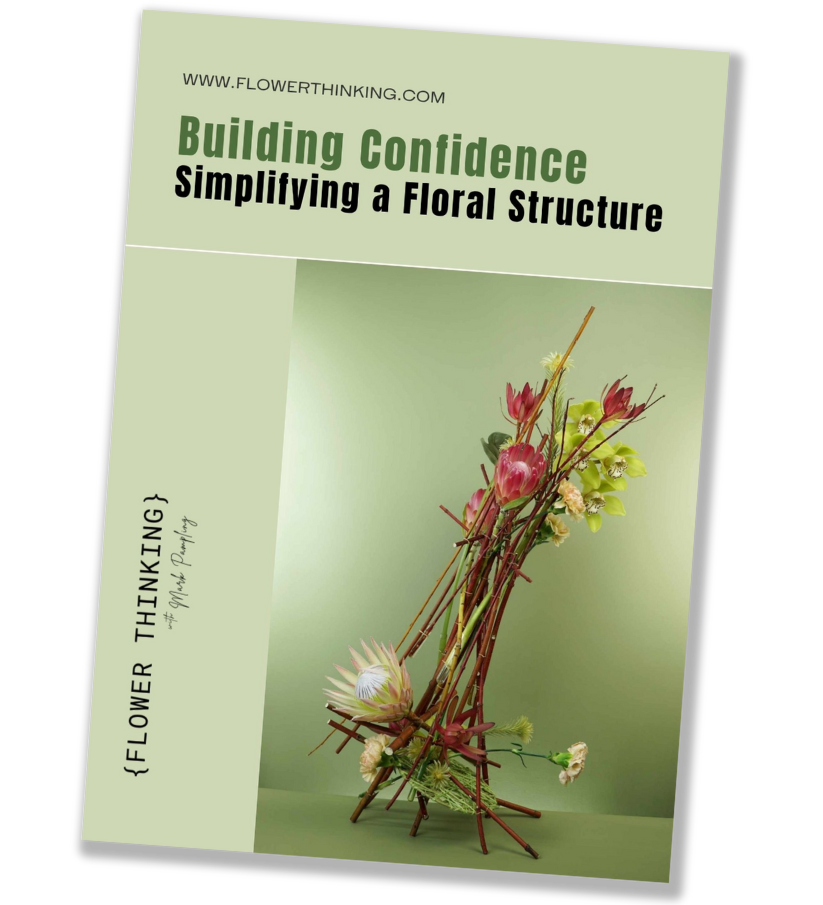
Use construction methods and mechanics that you are comfortable with to make your designs work for you. You might choose techniques you're already confident with, or experiment with something new. You might also want to use prefabricated structures such as baskets or frames salvaged from something you made before. Mark's eBooks Building Confidence - Simplifying a Floral Structure and Interwoven Possibilities - Designing with Bamboo Mats offer a range of ideas around this.
The purpose of the second submission is to respond to what you learned from the first Design Forum, so you can keep or change the container, mechanics and materials as needed.
Where practical, retaining some visual connection between the two submissions can make the effects of your changes easier to see and discuss. That connection might come from the container, mechanics, materials, colour scheme or another recognisable part of the original idea, but this is a guideline rather than a requirement.
You can, but please take care to avoid changes to the photograph that alter the design itself. Careful choice of a neutral background and good lighting will help you avoid altering the colour balance of the materials in the design.
Use basic photographic editing to clean up stray background artefacts or compensate for poor lighting conditions, but avoid digitally altering the design itself.
Absolutely, and it is encouraged. The process of articulating your decisions to someone else often helps clarify your own design process.
Yes. Written notes are provided shortly after each forum, and are also captured in the final eBook, Competition Learnings.
The size limits here are defined in the schedule.
What participants say
Learned so much
I am thrilled to have found Designing to Win classes. Mark is an excellent teacher, looking at the work from both a competitor's and evaluator's point of view. I learned so much watching his thorough critiquing of each design and suggestions on improvements. I would love to try this as a competitor next time. A great educational experience!
Boosted my confidence
This course has boosted my confidence and understanding of what is expected in good floral design. The practical, eloquent and positive feedback has been really valuable. Not only does Mark possess true natural flair and talent, but also comes with vast experience and above all, is an excellent teacher who is able to clearly share his understanding with his students.
Enjoyed the feedback
I enjoyed the feedback sessions on the designs, particularly when shown the changes that could be made to the designs to improve them. Mark had a great way of explaining aspects and reasons for the changes he would suggest.
In-depth analysis
Mark's Designing to Win course exceeded my expectations - his analysis of each of the compositions presented and his recommendations on how to strengthen the piece was quite in-depth. I learned much more from attending as a member of the audience than I thought possible. I would love the opportunity to attend as a participant.
Good Learning Curve
This is a good learning curve for any designer who is wanting to sharpen up on the skills required when competing in shows.
Useful Examples, Detailed Instructions
Mark has a unique way of looking at design and he has brought that again with this Festive Thinking 2023 short course and tutorial. What I like about his courses are he gives you suggestions of useful techniques, detailed instructions and many examples of unique completed designs for inspiration. After you’ve submitted your design Mark reviews it and gives a detailed constructive analysis about the work. He indicates what works and what improvements or other possibilities to enhance the design. Always insightful and thought provoking. In addition to this, it is so good to see how other participants interpret the brief and the amazing designs they create. It’s a great opportunity to delve into the world of floral design. Highly recommended.
Top Tips for Floral Competition Success
Make these tips your own
Apply the analysis to your own design, or study it across the field.
Handle difficult themes with more confidence. See the schedule
Put your effort where the marks are. Join below
Make designs that score as well as they look. See the forums
Grow from a whole field of designs, as a Designer or an Observer. See how to join
Hear some of Mark's top tips for floral competition success in this 45 minute talk, gleaned from 35 years competing in, judging and convening floral design competitions.
The Guide
The Guide explains how Designing to Win works in practice and gives you a reference to use as you prepare for the programme and work through each stage.
Use it to check your course dates and meeting format, understand how the programme cycle unfolds, and see what to expect from the Design Forums, feedback process and analysis.
For Designers, it also covers choosing materials and mechanics, preparing and submitting your work, and photographing your designs accurately for review. It includes practical guidance on revisions, missed work and support, so you can find the information you need as the programme progresses.
Reserve your place
Designer or Observer
Three eBooks with their companion videos, and two live Design Forums.
Maximise Your Success In Competition
Designing to Win gives you a competition-style design problem and a structured way to examine the decisions that shape the result.
Join as a Designer and develop your own response to the schedule. Your work becomes part of the shared analysis, then you apply what you learn through a second response.
Join as an Observer and follow the same process without producing your own submission. You can concentrate on the complete field of work and study the analysis with some detachment from the pressure of creating.
In both modes, you receive the same programme materials, three eBooks with companion videos, two Design Forums, recordings, written notes and opportunities to ask questions.
The Forums examine interpretation, design, workmanship and overall effect, using the competition schedule and marking criteria as a framework for analysis rather than ranking.