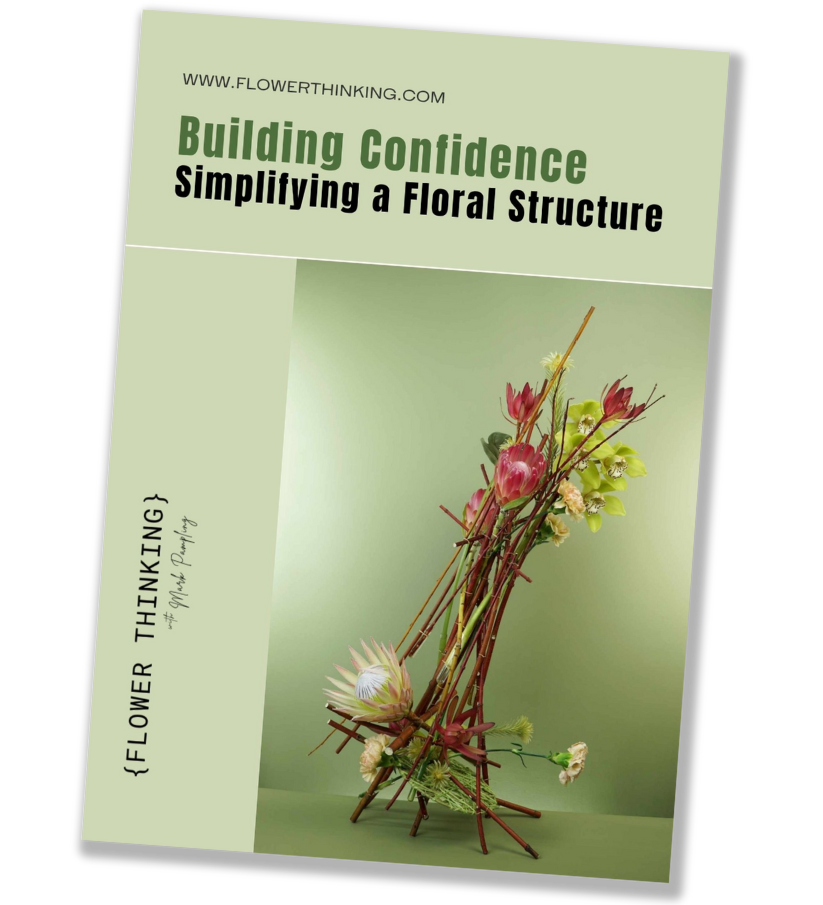


Advanced Directions
Most of our design work happens within a small number of comfortable combinations that we reach for instinctively. Advanced Directions exists to break the mould when comfort turns to complacency — take this journey beyond familiar patterns and return with fresh ways of thinking about, seeing and creating floral design.

Beyond comfortable combinations
Advanced Directions takes us on a journey from our comfort zones through a landscape where rarely-paired principles are explored together. In four tasks over eleven weeks, we remove a combination we'd normally reach for and work with one we wouldn't have chosen.
A symmetrical silhouette built from overlapping rather than radial line systems. An asymmetrical, formal-linear design, with less material and more negative space. A design directed horizontally, challenging us to distribute mass and space across a shallow, wide plane. A hanging or suspended design demanding concentrated attention to the technical requirements.
Across these four tasks we notice the same recurring pattern, a reversion to comfortable ways of working. Perhaps designs lean toward unneeded symmetry, or silhouettes stay unnecessarily contained. Or perhaps we notice line systems reverting to the familiar, even when that doesn't serve the design.

Is this for me?
Advanced Directions is for anyone who creates with flowers and wants to elevate their thinking, design process and understanding of how design works. There are no prerequisites for this course other than a basic ability to make floral arrangements, and some knowledge of, or curiosity about, floral design principles.
Advanced Directions asks for a willingness to work against habit, to stay inside an unfamiliar way of working long enough for it to become familiar. The reward is a fresh perspective, the ability to see our designs more objectively, and a wider creative range than we started with.
Design Directions and Advanced Directions are companion courses, rather than a sequence. Design Directions works with more open-ended creative freedom, while Advanced Directions narrows the parameters deliberately, so there's less room to fall back on what already feels comfortable.
Four briefs, each one changing something
During the course, materials, silhouette, line system, and direction of energy all shift from one task to the next, so a solution that worked for one design can't simply be repeated for the next.
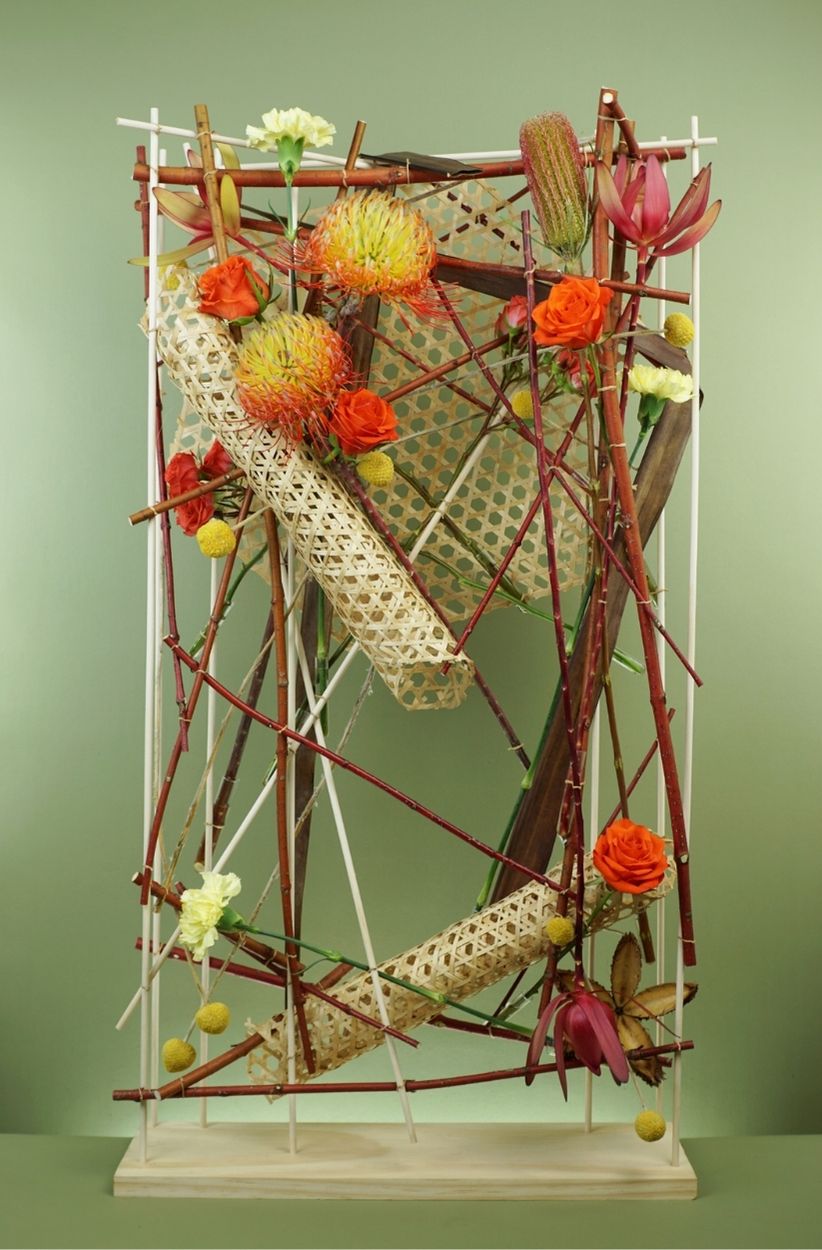
Symmetrical Silhouette
Our first task asks for a symmetrical silhouette built from overlapping lines, with height as the dominant dimension. Materials face in every direction rather than emanating from radial points, and the eye reads the overlaps as an impression, not a literal structure. The brief leaves construction methods and materials open. What's fixed is the outline, the organising system, and the direction of energy.
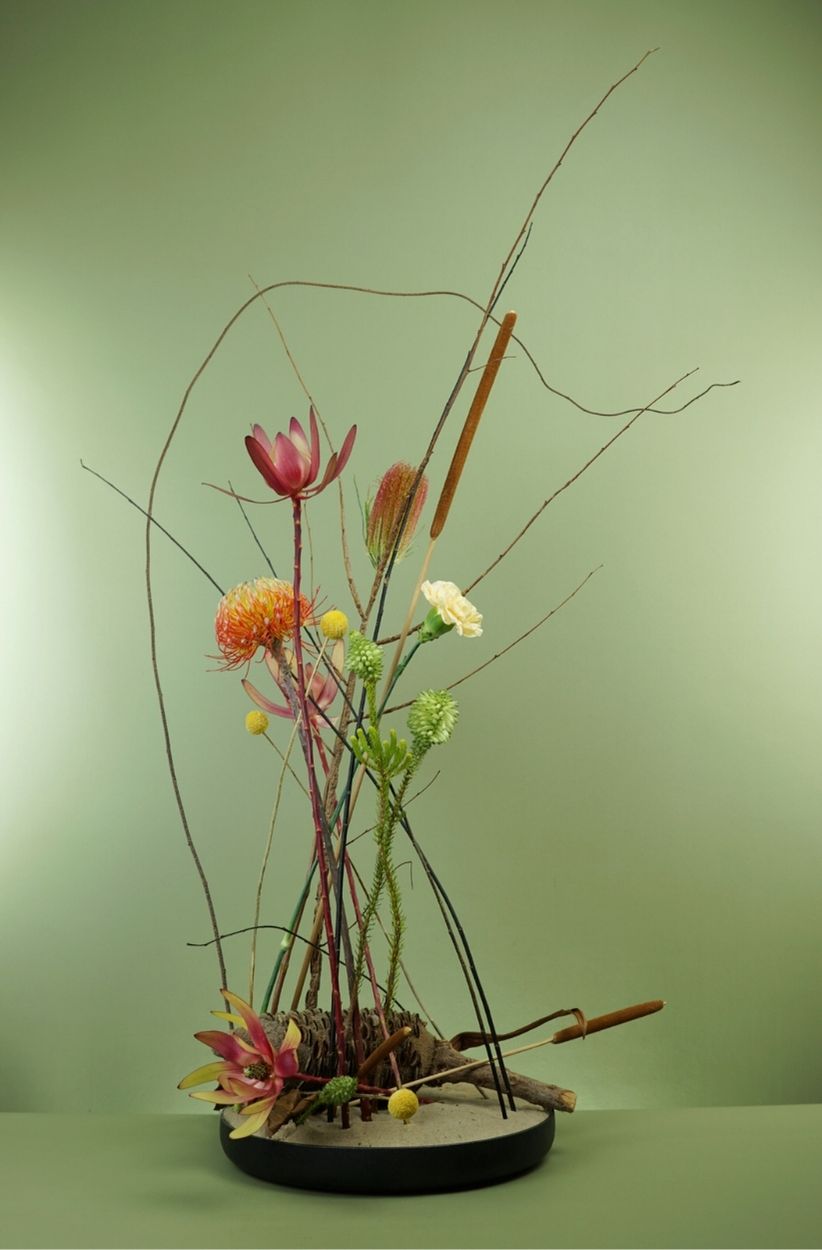
Overlapping Formal-Linear Design
The second keeps the overlapping system but strips the silhouette back to asymmetry and the style to formal linear, with less material, so each individual line and form has to hold its own weight. Where the first task rewards density, this one embraces emptiness. Negative space becomes the main tool for keeping each form legible, and grouping is only permitted where the individual materials inside a group can still be seen.
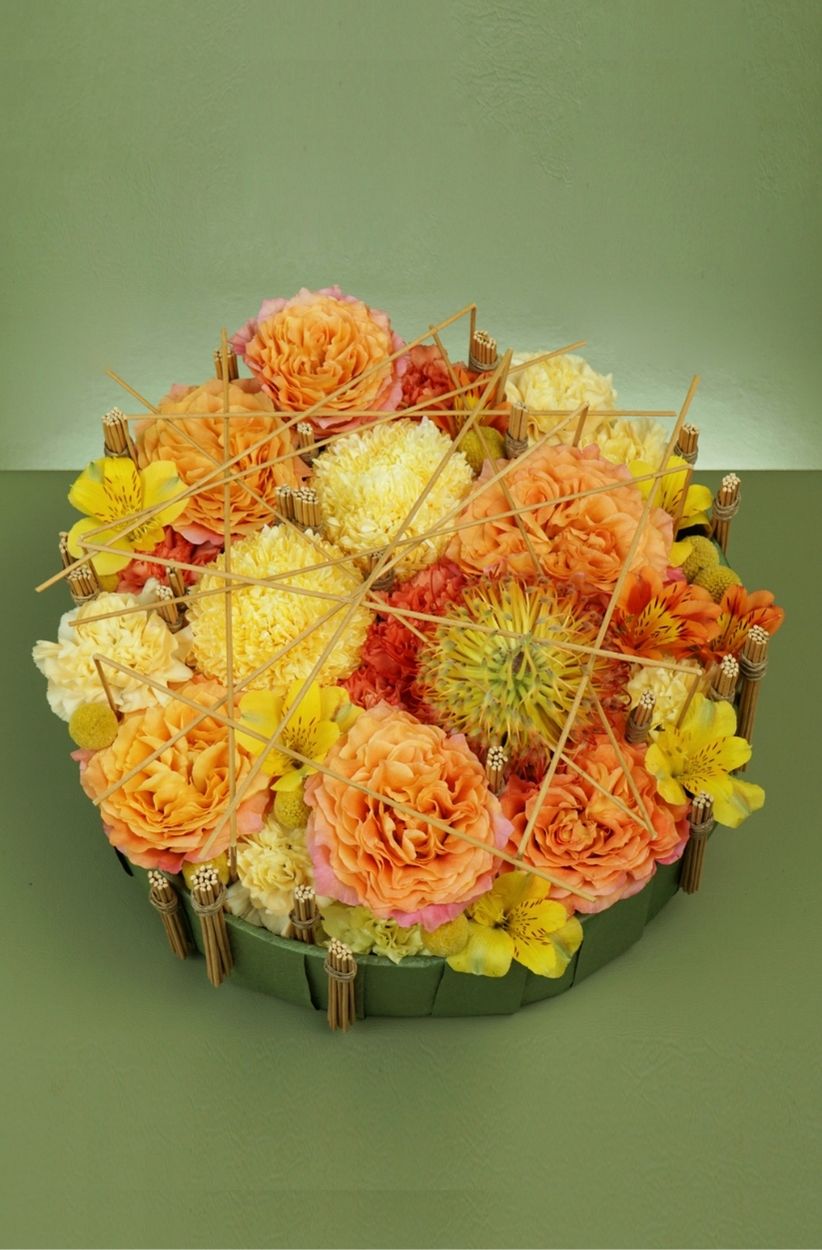
Shallow Depth Parallel Design
Then we turn the design on its side. Parallel lines, proportions directed horizontally, working shallow instead of tall. Height, the dominant dimension in the first two tasks, is now the one to minimise. Because the task is decorative, more structural elements are allowed, but the shallow depth itself becomes the main constraint to resolve.
Suspended or Hanging Design
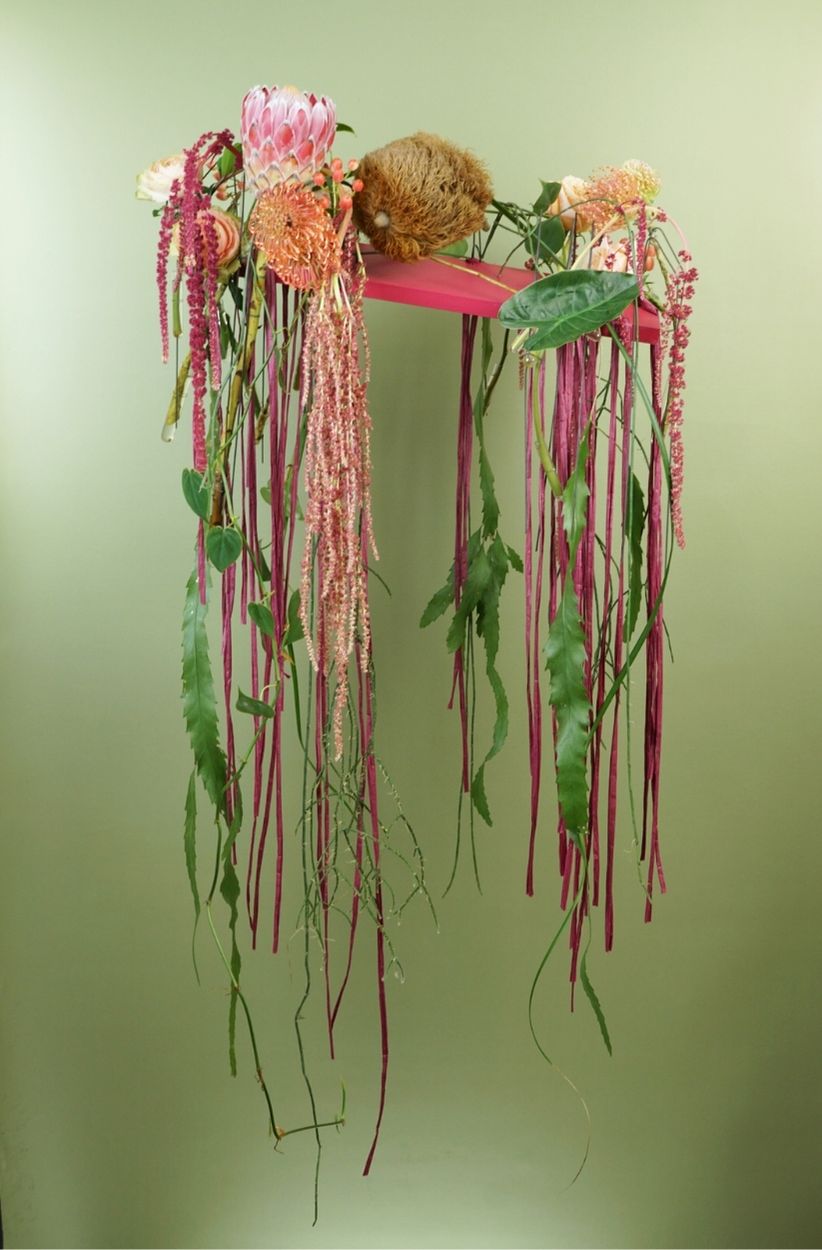
Finally, we change the physical structure of the design itself, working with a hanging or suspended form and downward-directed proportions rather than upward. The design's means of physical support, whether from a wall, a prop, or a point above, has to be considered from the outset, not added afterward. This task carries more freedom of choice than the earlier three, but demands the most fundamental change in how the design is built.
All our designs reviewed in every session
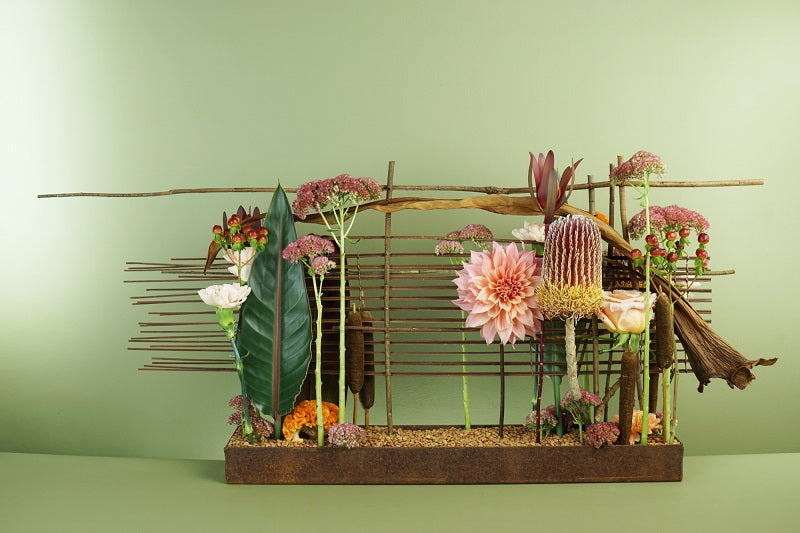
After each design submission, we join a live session where every design is reviewed in turn, our own included. Mark completes each task too, and applies the same critique to everyone's work, including his own, working through where designs fall short, and offering solutions.
Along with spoken feedback and written notes, Mark talks through the images of the designs, graphically indicating points under discussion, and provides edits to show how the suggested changes would impact the design in real life.
The same questions recur throughout, across changes in materials and brief: Where does the eye enter this design? Does a hidden radial point draw the eye away from our intended focal areas? Does the silhouette imply a shape the brief never asked for?
That's the mechanism at work. Not a series of isolated corrections but a consistent diagnostic process applied repeatedly against different problems. Over time, we form the habit of asking these questions ourselves, rather than waiting for someone else to point them out.
The timetable
Meetings run for sixty to ninety minutes, depending on the number of participants and the liveliness of the discussion. Submissions are by email; Mark gives the details in the first meeting. Recordings and written notes are emailed after every meeting and stay available for twelve months.
Mark Pampling

What shapes this course is Mark's belief that the most useful thing a designer can acquire is not a style or technique, but a diagnostic habit: the ability to look at one's own work and clearly see what is happening in the design, plainly and without flinching, where the eye actually goes. Mark believes that the best way to grow as a designer is to leave the familiar behind — even if just for a season — and return with a new way of seeing things.
Mark has been designing, competing, teaching and judging for three decades.
Before you decide
A working familiarity with floral design fundamentals is assumed — advanced mastery is not. If you can build a design and talk about why you placed things where you did, you have enough.
This is for designers and artists who want to understand their own creative pathways better. Some essential skills and knowledge, or simply curiosity about design principles, is enough to grow with us. It isn't a competition, and nobody's work is measured against anybody else's.
Absolutely. Advanced Directions is built to be respectful of every level of experience and inclusive of every floral background — floral artists, flower arrangers, floral designers and florists are all welcome. Mark holds that the principles of floral design apply across all creative floral traditions.
No. The recording plus detailed notes are emailed after every meeting, so you can catch up at your leisure. Attending live is worth it if you can — it's your chance to ask questions and talk the work through with Mark and the rest of the group — but the course is designed to work either way.
Most participants devote between three and ten hours to each task, including the online meetings, which run for sixty to ninety minutes. You'll have two weeks before the first task and three weeks before each of the others.
Pricing is deliberately flat so the course is as affordable as possible for everyone — which means there are no group rates to chase and no discount to wait for.
They're companion courses rather than a sequence. Design Directions works with more open-ended creative freedom, while Advanced Directions narrows the parameters deliberately, so there's less room to fall back on what already feels comfortable. Either can be taken first, and many people take both.
Wherever you can. "I'm a firm believer in resourcefulness," Mark says. "I'm lucky to have a florist shop with stock I can use, but I also forage from my own garden, the roadside or friends." Fresh, dried or preserved material is all welcome, in any combination. Nothing extravagant, expensive or exotic is expected — the briefs reward restraint, so most tasks want fewer stems than you'd think.
There's no fixed toolkit and no required technique — mechanics are entirely your choice. Use methods you already know, or treat the course as a low-stakes place to try new ones. For submitting work you need a camera or a phone, a plain backdrop, a simple table or plinth, and reasonable light.
A phone is fine. What matters is that the photograph represents the design honestly, because the critique works from the image: a clear background, diffused light from more than one direction rather than a single strong light front-and-above, a border of space around the design rather than a tight crop, and no filters. Send one to five images, always including a full-outline shot. The guide covers this properly.
Yes. This sometimes happens. Ideally before the second online lesson, to allow you time to catch up with the material and complete your first design submission.
Yes — everyone in the class sees all the submitted work, which is where a good deal of the learning comes from. Outside the class, we may feature your work with attribution in social posts, campaigns or our galleries, but only with your permission.
Reserve your place
Eight places, eleven weeks
Five live sessions, four practical tasks, feedback on every design.
How the course actually runs
See how Advanced Directions works in practice, from the four design tasks and live reviews to photography, submissions, support, recordings and materials.
You'll know what to expect before you join, including how each task unfolds and how feedback and group discussion support your learning.
- Your course dates and meeting format, ready to save or print
- How each task and submission works, step by step
- Photography guidance, so your work is represented fairly
- Materials, mechanics and self-evaluation guidance to keep beside you throughout the course